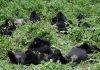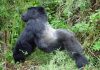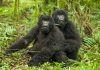
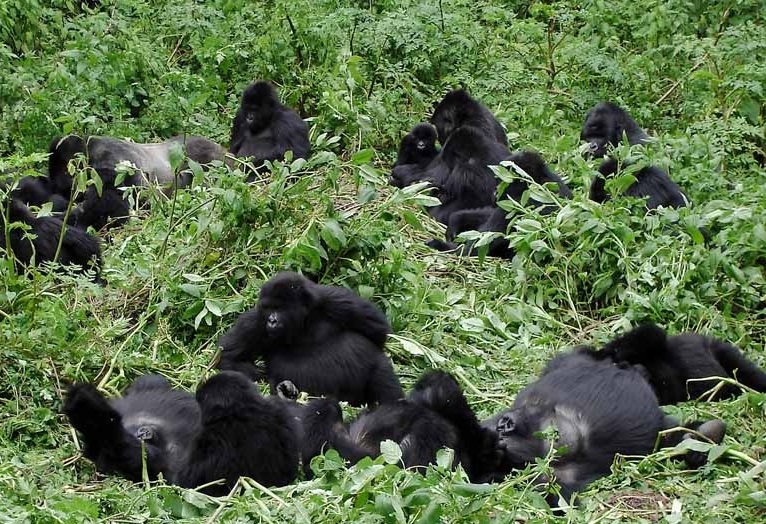
The Virunga Volcanoes that separate the Democratic Republic of Congo, Uganda, Rwanda and Bwindi Impenetrable National Park were first discovered by British explores in 1861. It was later, in 1902 that the gorillas were discovered.
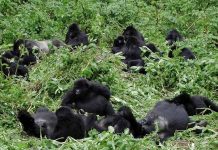
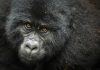
Mountain gorillas are found in two separate locations: the Virunga range of extinct volcanic mountain on the borders of the Democratic Republic of Congo, Rwanda and Uganda, and in the Bwindi Impenetrable National Park in Uganda.
However, the mountain gorilla species was made famous through the research of Dian Fossey, she lived with them in the forest, raised funds for rangers and protected the gorillas despite extreme danger from poachers, culminating in her unsolved murder in 1985 and today this species’ survival depends more on the local people of these countries than any other factor.
Mountain gorillas are one of the rarest large mammal species in the world. Their small and fragile populations are found in a truly remarkable region of Africa, the western rim of the Greet Rift Valley, where the drainage basin (watershed) of the Nile River is separated from that of the Congo River, the two largest rivers of the continent, and the second and third largest rivers in the world.
Mountain gorillas sleep in nests which they build on the ground or in trees, depending on various variables, such as the vegetation and the security situation. Every evening mountain gorillas construct a new nest, even if it is only a few metres from the nest they used the night before.
In Bwindi Impenetrable National Park, gorilla tourism started way back in 1993, when the Mubare group became the first family to be fully habituated to humans. Today the park is home around 480 gorillas with 14 fully habituated families available for trekking.
It’s more than a day’s drive from the capital Kampala or a quick flight to get to Bwindi Forest, but it’s worth it. Bwindi is a World Heritage Site with over 350 bird species and 200 kinds of butterflies and, thanks to income from gorilla trekking, its mountain gorilla population has grown by a third in recent years.
Gorilla trekking is an unforgettable, life-changing safari experience that can be done every day in Uganda’s Bwindi Forest. The day starts at the Uganda Wildlife Authority headquarters in Bwindi, where guests are allocated their gorilla group and guides before being briefed on essential do’s and don’ts to follow while in the forest.
8 people are allowed to trek each gorilla family, staying for a maximum of 1 hour in their presence. Bwindi is aptly named the” Impenetrable” forest”, paths pass through dense vegetation and can be steep. Take advantage of walking sticks offered at the start of a walk.
The gorillas habituated for tourism are in families based at different trailheads. When you choose to visit Bwindi, be sure to know which trailhead you are allocated before you book your hotel. After knowing your allocated trailhead then you can book the hotel in that location.
Now the park has set another new precedent creating an experience for visitors that involves tracking semi-habituated groups. The new experience is called the Gorilla Habituation Experience Gorilla habituation experience is a teaching process for gorillas with an aim of getting them familiar with human presence in their jungle forests.
Gorilla habituation is a long process involving gorilla adaption and only done by gorilla researchers and well-experienced rangers who meet with the gorillas every single day to train and monitor their progress. The Habituation process involves giving names to each gorilla and training them to acknowledge these names, while closely observing their behaviours.
This is very challenging at the beginning as gorillas tend to run away from researchers moving deep into the forests. It is a very slow process that can take years. The gorilla habituation takes up to four hours and the number of people allowed for gorilla habituation is limited to four people or less per day.
The Gorilla Habituation Permit costs $1500 per person per. The gorilla habituation safari is only offered in Uganda and only in the southern sector of Bwindi forest. During the habituation, trackers visit wild gorilla groups every day for around three years with the intension of getting closer and spending longer in their company.
At the semi habituated stage, the primates are familiar with trackers, so this new experience can now help them get used to seeing different people. The gorilla habituation gets you more value for your money than the one hour with a gorilla family.
So the difference between gorilla trekking and gorilla habituation experience is that a gorilla trekking safari can be done in all other mountain gorilla destinations, while gorilla habituation is limited only to Bwindi Impenetrable National Park in the Rushaga region, and can only be done with the Bushaho gorilla family and Bikingi group.