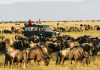

Renowned for being one of the country’s best destinations for game viewing and wildlife conservation, Murchison Falls National Park undoubtedly offers a unique experience.
The park covers an area of 1557 sq. miles (3860 sq.km), situated in north-western Ugandan and is the country’s largest faunal reserve.
The park is bisected by the Victoria Nile from Karuma Falls at its eastern border to Lake Albert in the west. To the north of the river is Acholi land and to the south is Bunyoro. The park is bordered in the east and south by Karuma Game Reserve and Bugungu Game Reserve.
First gazetted as a game reserve in 1926, it is Uganda’s largest and oldest conservation area, hosting 76 species of mammals and 451 birds. The park is bisected by the Victoria Nile which plunges 45m over the remnant rift valley wall creating the dramatic Murchison Falls.
For 80km between Karuma Falls and Murchison Falls the river is a rushing torrent of water which drops about 300 metres.
As it spills over the ancient rocks that form the Western Rift Valley wall, much of its youthful energy is lost in the force with which it explodes through the 6 meter gorge and into the cauldron of turbulent water below known to fishermen as “Devil Cauldron”.
The Nile continues on a slower, wider course for another 28km until it reaches Lake Albert. It then flows steadily north, where for 30 km it forms the north-west boundary of the park.
A history recounts, in 1863, the explorer Sir Samuel Baker and his wife followed the Victoria Nile upriver from Lake Albert to the base of the falls. Baker was overcome by the ferocity and beauty of the spectacle and he wrote in his diary on the 3rd of April 1864.
Ironically, both this description and the sketch in his notebook, seem to refer to the second overflow falls slightly north of the existing, much narrow and more dramatic cascade known to all since then as “Murchison Falls”.
However, the legend was born, many more explorers and travellers followed the Baker and returned to Europe and America with fantastic tales of adventure and wonder. Murchison Falls became a landmark, a place of crocodiles and hippos, a place where the savage profusion of nature was expressed in a short expanse of undisciplined wilderness.
Activities to do in Murchison Falls National Park
Murchison Falls National Park is an exceptional excursion where one can do a water and land safari in the same day, as a visitor to the park you will be in no doubt familiar with some of the history and romance associated with Murchison Falls.
Wildlife Game Drives
Early mornings are unquestionably the best time to see and photograph animals. The Nile Valley is one of the hottest places for a Uganda Safari. Animals tend to look for shade and rest once the sun gets out.
A game drive around the Buligi game tracks on the northern bank with a trained ranger guide is a fantastic way to see and photograph the wide range of animals in the Nile Valley.
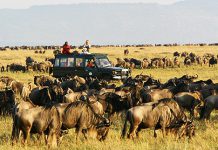
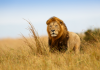
You will spot many animals during your game drive such as lion, leopard, hyena, buffalo, warthogs, bushbucks, reedbuck, duikers, Kobs, Oribi, and the unusual looking hartebeest. In Murchison Falls, there are three prime areas of interest for game drives on the north bank. The best for viewing animals is the Buligi Circuit, which includes the Buligi, Victoria Nile, Queens and Albert Nile tracks.
Boat trips
The 3 hour launch trip from Paraa that heads up to the base of the falls is a highlight of the park for many visitors and presents an astonishing display of wildlife and culminates with the memorable frontal view of the falls.
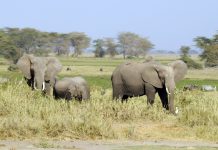
The launch departs at 9am and 2pm daily and takes 3 hours. There are abundant hippos, crocodiles, elephants and buffaloes to see along the waters. The trip climaxes with fantastic frontal views of Murchison Falls, around 500m from its base.
The birds along the Nile can be thought of in three main groups. Firstly, there are those that feed in open water such as darters, cormorants and ducks.
Secondly, there are those that hunt the river margins with specially adapted physiology such as herons, kingfishers, storks, ibises, egrets, stilts, geese and the ever-present fish eagle.
Finally, there are birds that feed off the insects that rise from the water and these include the migrant swallows, some bee-eaters and pranticloes.
Top of the Falls
A visit here must form an integral part of any trip to the park. It is a unique and breath-taking natural spectacle, the most powerful rush of water anywhere in the world. There is a small camp site ranger post at the falls and this is a starting point for several interesting and testing walks.
The rangers know their way around and should be consulted on the correct paths to follow. The closest is the short walk down the hill to the water edge. Here it is possible to get within a few meters of the falls.
The narrow gip and the volume of water the rages through it, vibrating the ancient rocks, can only truly be appreciated from his vantage. At the side of the falls, a pathway leads up to a shelf that gives a slightly elevated view back towards the falls.
Forest walks
The drive from Kampala to Masindi takes about 3 hours; there are two possible routes into the park from Masindi. The more direct routes pass through the thin Kaniyo Pabidi Forest Corridor which joins the Budongo Forest to the much smaller Pabidi forest.
Budongo has one of the longest recorded logging histories anywhere in the world and thus makes an excellent location for studying forest regeneration in the wake of selective logging and its impact on wildlife.
It is possible to stop in the forest reserve on either road; trails through Kaniyo Pabidi and Rabongo forests provide sightings of many primates and birds. Walks are led by trained guides who give a fascinating insight into the ecology of the forests.
The bird life is extremely rich, and particularly rare forest species include the blue throated roller, dwarf Kingfisher, velvet mantled drongo and grey-chinned sunbird. During the 2-3 hours walk in the reserve it is usual to see 50-60 different bird species. In total, there are 332 different species documented so far. The Kabalega drive is citied as the best bird watching site in Uganda.
Chimpanzee tracks in Budongo Forest
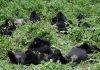
The main attraction of the walks is the prospect of viewing habituated chimpanzees. There are estimated to be between 400-800 chimps in the reserve.
The habituation work on chimpanzees is difficult in the forest because troops move over extensive areas, generally looking for seasonal fruiting trees.
Chimps habitually prepare nests for themselves every evening, weaving a simple mesh of branches into the fork of the higher branches of a tree in which they might have been feeding. The walks are restricted to six per group.
Sport fishing
Fishing for Nile perch is the major attraction for anglers in the park waters, the most exciting place to fish in the fast flowing waters above the falls and below the falls.
The normal catch ranges from 20kg to 60kg, but the record haul is 108kg. You can fish from the shore or get a boat, being a national park, fishing here is strictly catch and release.
Cultural encounters
The remote community of Mubako is located beside the sprawling savannah of Murchison Falls National Park. The village is a cluster of traditional thatched huts around a clearing where villagers gather to escape the midday sun under the shade of a large tree.
At the dusk, the local cultural groups perform vibrant songs and dances around the campfires of local lodges, accompanied by the beautiful sound of the Adungu.
There are few economic opportunities in this region and the climate makes farming hard, but with the money generated through tourism, the community can buy produce from local markets pay school fees and support a nursery for children.
Hot Air balloon safari
Enjoy the unique experience of flying in a hot air balloon with one of the following options only available at Murchison Falls National Park.